For many years, social media was often seen simply as a communication channel—a place where brands distributed content or launched campaigns to increase awareness. However, as consumer behavior becomes increasingly tied to social platforms, the way brands understand and engage with the market is also changing. Conversations on social media today almost instantly reflect how consumers think, feel, and respond to brands. From needs and emotions to emerging trend signals, everything is expressed through the daily discussions taking place on social media. In this context, many marketers are beginning to adopt a Social-First approach—placing social media at the center of their marketing strategy.

In the first two months of 2026, the Tet topic attracted nearly 100 million discussions. In addition, 148 campaigns from 35 different industries convey the message about the New Year. However, behind the numbers above, Tet 2026 marks major changes that could affect how brands approach the 2027 New Year. Not only in terms of subject, time, background but also the transition from “noisy” to “dialogue”. Buzzmetrics' latest report will analyze four key points drawn from the Tet Campaign 2026.
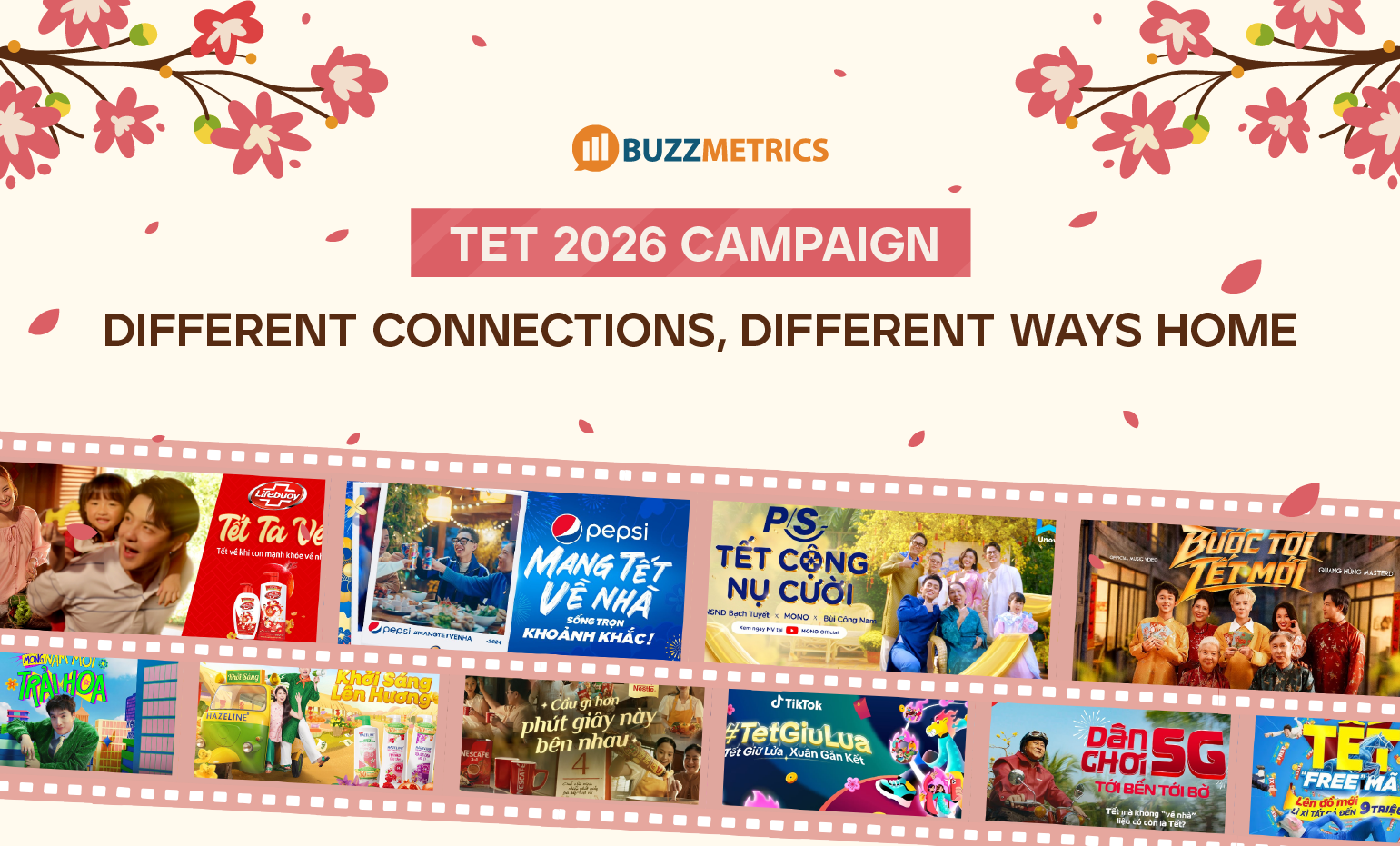
Tet 2026 continues to be a major battleground for brands, where the story of “Coming Home” is no longer told through familiar formulas, but reinvented through diverse and meaningful ways of connecting with audiences. As of January 21 — nearly halfway to Tet — 111 marketing campaigns from 32 industries had already been launched Tet Campaign.
The Lunar New Year (Tet) season has always been the most fiercely competitive "battleground" of the year for Vietnamese marketers, where brands pour their full resources into capturing the minds and hearts of consumers through the Tet campaign. As no exception, the upcoming Tet 2026 is forecasted to witness a race more intense and cutthroat than ever before.
.png)
In the banking industry—where brand trust, digital experience, and the speed of information diffusion play a critical role in building and sustaining customer loyalty—social media data should not be leveraged only when a crisis occurs. On the contrary, social data continuously and directly reflects the needs, expectations, and “pain points” of financial service users, ranging from service fees and transaction processes to digital platform experiences and expectations for new banking features. When systematically analyzed, insights derived from social listening become a strategic input for banks to inform product development, optimize the customer journey, and fine-tune communication strategies in line with market context and evolving consumer behavior. Therefore, the key question is no longer whether banks need social listening, but rather how millions of social conversations can be transformed into timely, focused decisions with measurable business impact.
_11zon.webp)
Matcha has become a global beverage phenomenon in recent years, even leading to shortages in Japan (according to Thanh Nien Newspaper). In Vietnam, the matcha market size is forecasted by Mobility Foresights to grow from USD 340 million in 2025 to USD 500 or even USD 780 million by 2030. Furthermore, according to IPOS, consumers are willing to pay an extra VND 10,000 - 20,000 for a high-quality cup of matcha. So, how is matcha being discussed on social media?
With over 1.1 million discussions and 53 million views across social platforms, “Năm Số 9” (“Year of Cleansing”) has emerged as one of the most viral social slang of 2025. Commonly associated with online drama and emotional turbulence, it’s often used by netizens to explain or react to any chaotic event—especially in entertainment. However, Buzzmetrics’ data reveals a deeper, more nuanced story behind “Năm Số 9.” Beyond its “drama-laden” surface meaning, let’s uncover what lies beneath this social slang phenomenon.

Trí tuệ nhân tạo (A.I) với sự xuất hiện của ChatGPT đã tạo nên cơn sốt đầu năm 2023. Tại thời điểm đó, theo thống kê của Buzzmetrics, người dùng đã loay hoay với hàng loạt câu hỏi như “ChatGPT là gì?”, “ChatGPT có thay thế được con người không”, “ChatGPT có thể dùng trong lĩnh vực nào?”. Hai năm tiếp theo, chủ đề về A.I trên mạng xã hội đã có những bước chuyển lớn và ngày càng thâm nhập vào đời sống người dùng Việt Nam.
Social Media KPIs are key performance indicators that measure a brand's effectiveness on social media. These metrics play a crucial role throughout an entire campaign—from the planning phase to post-campaign evaluation. With years of experience in market research and advising top brands, Buzzmetrics has identified four key steps in building Social Media KPIs for successful campaigns: (1) Defining campaign objectives – Establishing clear goals for what the campaign aims to achieve. (2) Understanding the significance of each metric – Knowing what each KPI represents and how it reflects performance. (3) Aligning campaign goals with measurement metrics – Ensuring that the selected KPIs accurately track progress toward strategic objectives. (4) Avoiding common misconceptions when setting KPIs – Recognizing and addressing potential misinterpretations to ensure accurate measurement.