
Tet 2026 Campaign Spotlight: Different Connections, Different Ways Home
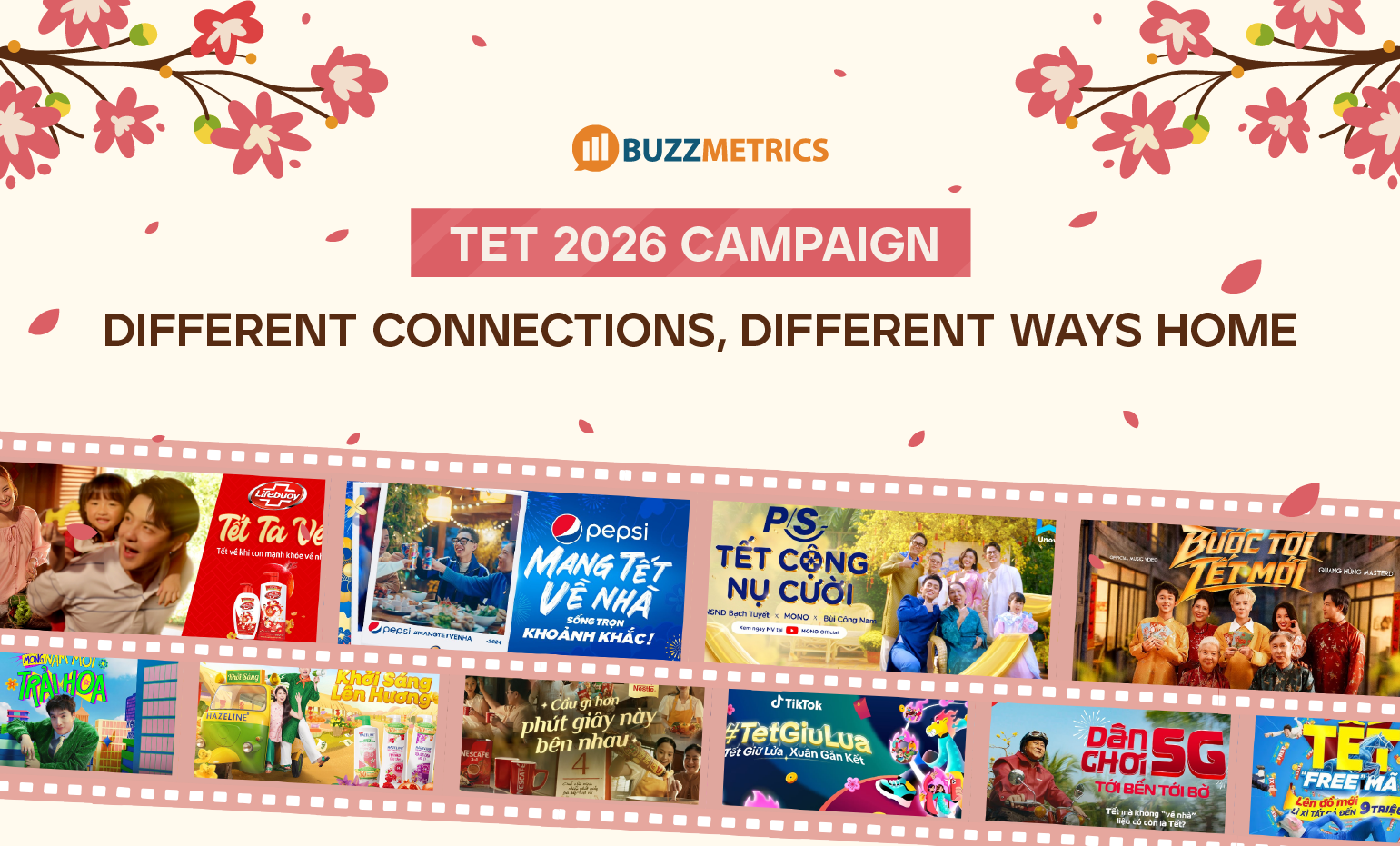
Tet 2026 continues to be a major battleground for brands, where the story of “Coming Home” is no longer told through familiar formulas, but reinvented through diverse and meaningful ways of connecting with audiences. As of January 21 — nearly halfway to Tet — 111 marketing campaigns from 32 industries had already been launched.
Overall, compared to Buzzmetrics’ previous update on January 8, the market saw more than 30 additional campaigns and six new industries joining the Tet race. Within less than a month, brands also released 24 music videos and short films featuring top artists, reflecting strong investment in the festive season. Although Tet was still weeks away, competition among Tet campaigns had clearly entered its peak stage. Amid the vibrant Tet marketing landscape, Buzzmetrics recognized the importance of highlighting standout campaigns that successfully created “real” connections with consumers.

1. The Rise of “Coming Home” Campaigns
As mentioned in Buzzmetrics’ previous blog, Content from Qualified Users became the key metric used to evaluate campaign engagement, replacing Buzz Volume as the primary measure of success. The ranking based on Content from Qualified Users revealed that half of the strongest-performing campaigns on social media centered around the “Coming Home” theme, creating genuine emotional connections with audiences. These campaigns included:
- “Tết Ta Về” by Lifebuoy
- “Mang Tết Về Nhà” by Pepsi
- “Cộng Một Nụ Cười Trừ Ngàn Khoảng Cách” by P/S
- “Cầu Gì Hơn Phút Giây Này Bên Nhau” by Nestlé
- “Tới Bến Tới Bờ” by Viettel

Over the years, “Coming Home” and family reunion have gradually become saturated Tet messages because of their familiarity. Consumers constantly talk about returning home for Tet, while brands continue to build campaigns around the same theme. During Tet 2026 alone, 23 campaigns focused on “Coming Home,” making it the third most common message after themes like prosperity and festive joy. So how did these campaigns approach such a familiar topic in a way that still created authentic connections with users?
2. Different Stories, Different Ways Home
All five campaigns told very different “Coming Home” stories. Pepsi delivered a more “classic” Tet story through the message “Golden Moments - Bringing Tet Home,” focusing on familiar images of people living far away trying their best to return home and reunite with family around the year-end dinner table.
This classic spirit was further reinforced through Pepsi’s annual CSR program in collaboration with the Ho Chi Minh Communist Youth Union, helping students, workers, and underprivileged people return home for Tet. In every TVC featuring Captain Boy, Pepsi incorporated familiar Tet imagery such as Chung cakes, ancestor altars, and family meals - all coming together to create the “golden moments” of reunion during Tet. The campaign’s momentum was also amplified by a large-scale music festival featuring artists such as Mỹ Tâm, Hòa Minzy, Bray, and Karik. As a result, Content from Qualified Users grew steadily throughout the first 20 days of January.

Meanwhile, Lifebuoy transformed “Coming Home” into an emotional reconnection journey built with remarkable depth and consistency.Instead of focusing on familiar Tet imagery such as fireworks or lucky money, the “Tet Ta Ve” campaign emphasized personal memories and emotional interactions between those returning home and those waiting behind. The campaign began with the “La Tet Cua Mot Ai Do” exhibition - a multisensory experience that guided audiences through nostalgic Tet spaces and encouraged personal reflection.
To sustain this nostalgic atmosphere, Lifebuoy later reintroduced iconic Tet songs from previous campaigns in remixed versions, maintaining audience engagement before eventually reaching a new discussion peak with the launch of the “Tet Ta Ve” MV. This was clearly reflected in the campaign’s Content from Qualified Users trend: conversations remained active during the first half of January thanks to the exhibition and smaller Tet stories, before exploding after the MV release.
Nestlé approached Tet in a much simpler yet still impactful way. Through the meaningful message, “Tet moments together are limited, which makes every present moment even more precious,” Nestlé partnered with Kenh14 and aFamily to launch the “Wishlist Ngay Luc Nay - Cau Gi Hon Phut Giay Nay Ben Nhau” contest. Another highlight was the “Tet Calendar for Today” - a minimalist calendar without dates, displaying only the word “Today” as a reminder for people to cherish the present moment of togetherness. Aside from support from major community pages, the campaign did not rely heavily on KOLs.
The campaigns “Cong Mot Nu Cuoi Tru Ngan Khoang Cach” by P/S and “Toi Ben Toi Bo” by Viettel brought fresh perspectives to the “Coming Home” theme. For P/S, enjoying reunion moments required overcoming not only physical distance, but also generational gaps. This message was reflected in the MV “Tet Cong Nu Cuoi,” featuring MONO, Bạch Tuyết, and Bùi Công Nam, blending modern pop music with traditional cải lương performance. The campaign also introduced a Gemini-powered microsite that helped families experience Tet across different generations.
Meanwhile, Viettel’s “Toi Ben Toi Bo” told a completely reversed “coming home” story. During Tet, people are often too busy to return home on time - so what if the family came to them instead? This unconventional idea was expressed through the message “If I can’t come home, then home will come to me,” leading to the journey of Meritorious Artist Tự Long in the short film “Dan Choi 5G - Toi Ben Toi Bo.” Although the short film was the campaign’s only major activity, its unique storytelling approach generated strong organic discussions. The campaign reached two discussion peaks: one during the film launch, and another fueled by organic user conversations on Threads.
3. Behind “Coming Home” Campaigns: The Shift in Marketing Platforms
This year’s standout “Coming Home” campaigns proved that even an old message can still resonate strongly when paired with fresh storytelling and new perspectives. Whether emotional like Lifebuoy, classic like Pepsi, culturally blended like P/S, simple like Nestlé, or unconventional like Viettel, each campaign found its own meaningful way to connect with audiences during Tet 2026. More importantly, these campaigns also reflected a larger transformation in the social media landscape: marketers now have far more platform choices for storytelling.
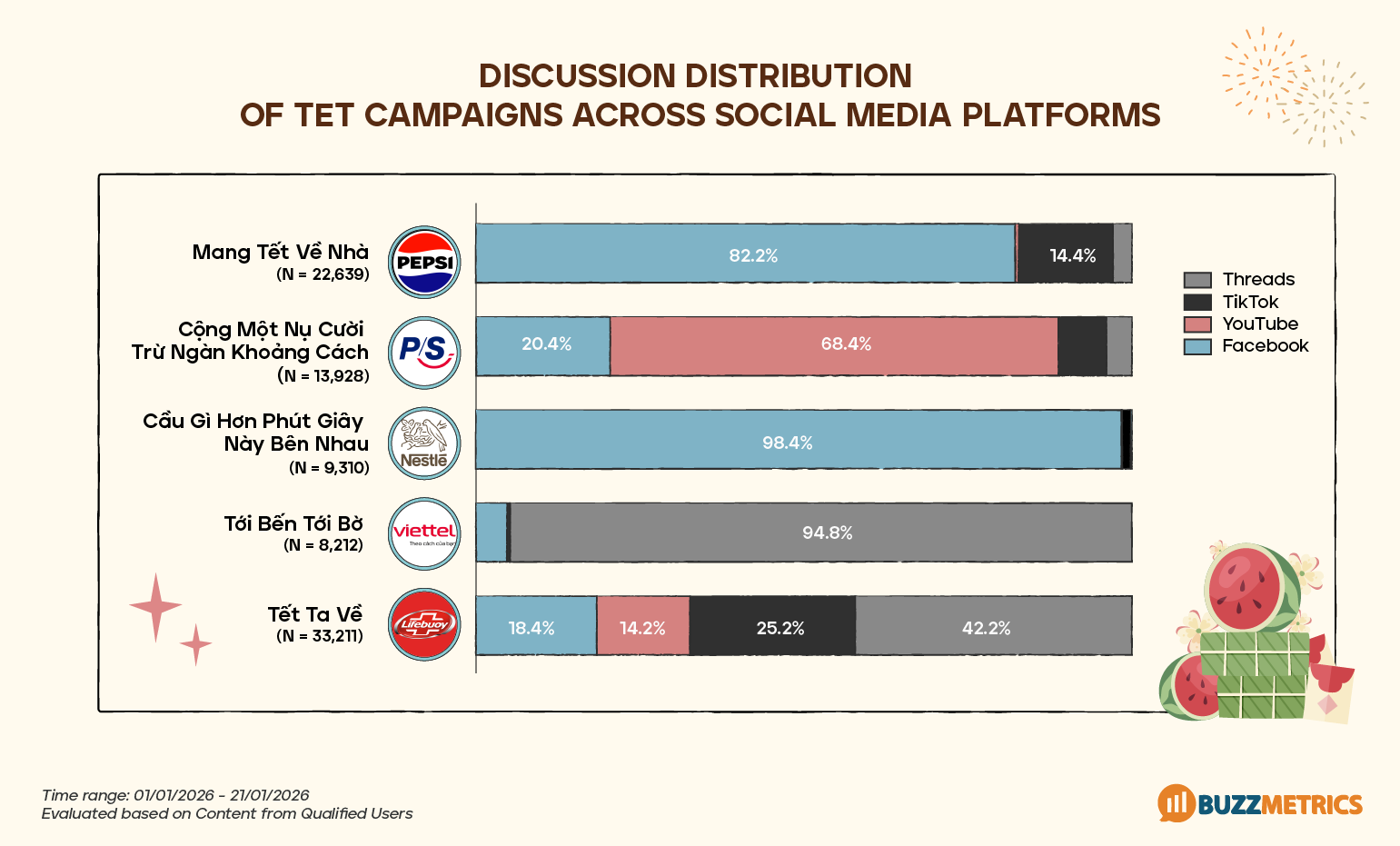
Five years ago, Facebook dominated both campaign launches and viral distribution. Most discussions from every campaign primarily came from Facebook. However, among this year’s standout campaigns, platform strategies became much more diversified. Nestlé’s minigame activities and Pepsi’s CSR initiatives still relied heavily on Facebook. Lifebuoy’s emotionally driven storytelling leaned more toward TikTok and Threads. P/S focused strongly on YouTube, while Viettel became the only campaign primarily driven by Threads. On Threads, users did more than simply watch Viettel’s campaign - many actively analyzed its message and praised its “out-of-the-box” storytelling style. As conversations spread organically, the campaign went viral on Threads with an overwhelming share of Content from Qualified Users.
Overall, with the rise of Threads and TikTok alongside Facebook, marketers now have more ways to tell their stories. At the same time, they must place even greater emphasis on storytelling quality to ensure Tet campaigns create meaningful impact. This shift reflects the inevitable evolution of Social Media Marketing - moving away from the “the louder, the better” era toward an era of “real people, real connections.”
Article Information



.png)
_11zon.webp)
.png)